Ever wondered why some digital characters seem so real while others feel stiff? The answer often lies in the small physical signs we use to talk. Studies show that 55 percent of total impact comes from non-verbal communication.
Creating content without thinking about movement is a big mistake. To make your digital subjects seem real, you need to learn ai porn video gestures. By focusing on smooth movements, you turn a simple scene into something engaging and believable for your viewers.
Knowing these physical signs helps you guide your projects better. This guide will show you how to improve your work with effective prompting techniques. You’ll learn to connect digital code with human feelings.
Key Takeaways
- Non-verbal signals drive 55 percent of communication effectiveness.
- Movement is more critical for character believability than static imagery.
- Precise prompting helps bridge the gap between technology and human emotion.
- Mastering physical cues creates a more immersive experience for viewers.
- Consistent practice with movement prompts leads to higher quality digital performances.
Understanding the Mechanics of AI Porn Video Gestures
Every smooth action in your projects is built on a complex system called latent space. This mathematical space is where models learn and show off human movements. Knowing this helps you control the look of your ai porn video gestures better.
The Role of Latent Space in Movement
Latent space is like a map for AI to understand human body and movement. When you give a prompt, the AI searches this space for the right order of frames. It doesn’t just copy images; it figures out how limbs and joints move naturally.
It’s key to know how keywords affect your results. If the AI doesn’t have enough data, the motion might look shaky or wrong. Improving your prompts helps the AI find its way better, making the gestures smoother and more real.
Bridging the Gap Between Static Images and Fluid Motion
Going from still images to moving videos is a big technical hurdle. Images need just one point, but videos need temporal consistency in hundreds of frames. The AI’s setup must keep the character’s look and size while showing off complex actions.
Modern AI uses smart algorithms to guess the next frame based on the last one. This dynamic simulation makes interactions seem alive, not stiff. By getting the hang of these tricks, you can turn simple pictures into high-quality, flowing videos.
Preparing Your Workflow for Realistic Animation
Creating naturalistic movement is more than just a fast GPU. It needs a well-organized production pipeline. A structured environment helps you master complex motion in your projects. This setup ensures your ai porn video gestures are consistent and engaging in every frame.
Selecting the Right AI Video Generation Tools
Not all platforms handle human movement equally well. Choose software that lets you control movement and skeletal tracking precisely. Selecting the correct tool makes a big difference in fluid motion versus stiff sequences.
When looking at platforms, focus on these key points for top-notch results:
- Temporal Stability: Tools that keep character and limb positions steady over time are crucial.
- Motion Control: Make sure the software supports custom motion vectors or depth maps for ai porn video gestures.
- Resolution Scaling: High-quality output is needed to capture small movements in faces and hands.
- Prompt Adherence: Choose engines that follow detailed anatomical prompts without adding extra limbs.
Setting Up Your Prompting Environment
Your workspace should help you avoid mistakes and boost creativity. Organize your prompts and test settings carefully to save time. A dedicated prompting environment lets you refine your ai porn video gestures quickly and maintain quality.
Begin by making a standard prompt template with detailed anatomical descriptions. This keeps your animation consistent. Consistency is the key to creating a top-notch animation library that shines online.
Mastering Descriptive Language for Body Language AI
Using precise language is key to making AI models look real. When you use body language ai, how well you describe body movements matters a lot. This lets you control how your characters act and interact.

Using Anatomical Precision in Prompts
Experts say hand gestures should start from the shoulders, not elbows. This makes your AI-generated characters look more natural and powerful. By telling the AI where movements start, you get more realistic results.
Be specific about which muscles are moving. For example, saying a fluid shoulder rotation helps the AI create a more natural movement. This ensures limbs move in a way that feels real.
Describing Weight and Momentum
Weight makes a character feel real. Without clear weight descriptions, movements can look too light or disconnected. You need to tell the AI how gravity affects your character for a grounded performance.
The Importance of Center of Gravity
The center of gravity affects how a character balances. If a character leans forward, say how their hips shift to stay balanced. This helps the AI avoid poses that don’t make sense.
Simulating Natural Resistance and Tension
Movements are never easy; they involve fighting against gravity and muscle tension. Use words like strained muscles or controlled resistance in your prompts. This tells the body language ai to work harder on poses, adding realism.
| Physical Concept | Descriptive Keyword | Impact on Animation |
|---|---|---|
| Weight | Heaviness | Increases grounding |
| Momentum | Inertia | Smooths transitions |
| Tension | Rigidity | Adds emotional depth |
| Balance | Stability | Prevents floating artifacts |
Step-by-Step Guide to Prompting Natural Hand Gestures
To get natural hand movements, you need both skill and creativity. Hands are key for showing emotions and building connections. Using body language ai means treating hands as active parts, not just background.
Defining Finger Placement and Interaction
For your characters to seem real, keep hand movements in the “gesture box.” This area is at navel level. This helps avoid weird or floating limbs that ruin the scene.
Be clear when telling the AI how fingers should move. Use specific words to help it create realistic hand poses:
- Relaxed grip: Say fingers should curve a bit, not be stiff.
- Spatial awareness: Tell the AI how far fingers should be from objects to avoid mistakes.
- Natural tension: Use “soft” or “fluid” to describe the hand’s muscle tone.
Avoiding Common AI Glitches in Extremities
Hands and fingers are hard for AI to get right. Give clear, detailed instructions to help the body language ai do better. If it gets fingers wrong, focus on what the hand should do, not how many fingers it has.
Here are ways to keep your images looking good:
- Simplify the pose: Start with simple gestures before trying harder ones.
- Use negative prompts: Tell the AI not to include things like “extra fingers” to clean up the image.
- Maintain consistency: Make sure hands look like the rest of the character’s skin to avoid a mismatched look.
By following these tips, your body language ai will give you better results. Practice these steps to get better at making digital characters look real.
Refining Facial Expressions and Micro-Movements
The secret to a truly responsive character lies in their facial micro-movements. While broad gestures set the scene, subtle shifts in the face add emotional depth. Mastering these small details greatly improves your body language ai output.
Prompting Subtle Eye Contact and Blinking
Eye contact is key for sincerity and engagement. Tell your model to hold eye contact for three to five seconds. This makes the viewer feel a real connection to the digital character.
Remember to include natural blinking in your prompts. A character that stares without blinking can feel off. Use body language ai terms like “soft, rhythmic blinking” to keep the eyes looking natural.
Capturing Emotional Nuance Through Jaw and Brow Positioning
The jaw and brow are key for showing emotions. A slightly lowered brow shows intensity or focus. A relaxed jaw means the character is open and calm.
For example, a “tightened jawline” can show stress or determination. A “softened brow” means empathy or curiosity. By adding these micro-movements, you create a highly credible performance that connects with your audience. Improving these facial cues is crucial for top-notch body language ai.
Implementing Acting Cues for Dynamic Interaction
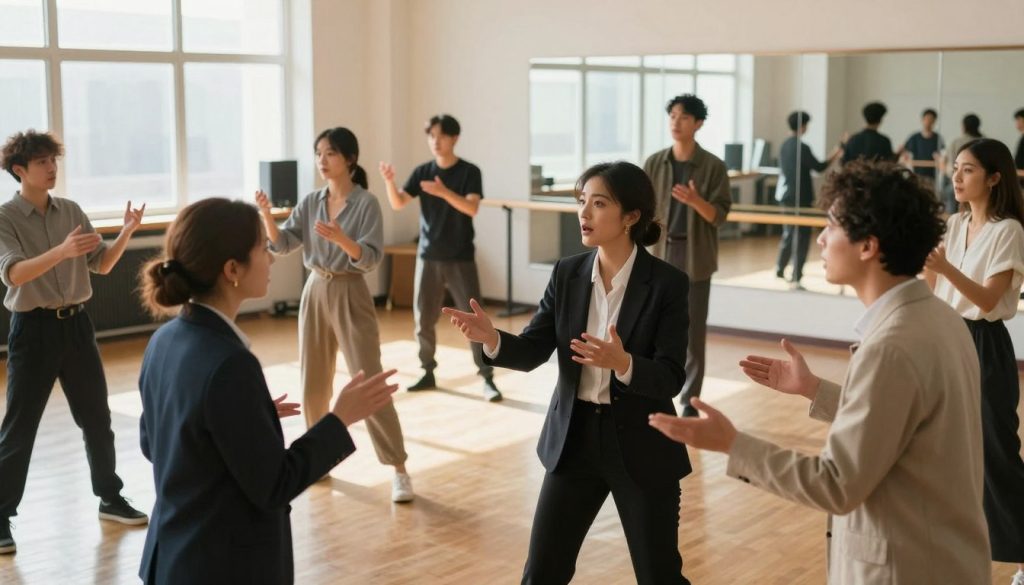
To make your AI videos better, treat your digital characters like real actors. Use acting cues to tell stories on purpose. This way, every action has a reason, just like a great actor does.
Directing Character Chemistry Through Spatial Prompts
Actors and lawyers aim to grab your attention and tell a story. Use spatial prompts to show how characters interact. Proximity and orientation are key for creating tension or closeness.
Setting the distance between characters changes the scene’s energy. Tell the AI if characters should lean in or keep their distance. This makes their connection seem real and not forced.
Using Action Verbs to Drive Performance
To make animations seem alive, use specific action verbs. Instead of saying “move,” say hesitate, approach, or recoil. This gives the AI a clear goal, making the animation look more natural.
Choosing strong verbs helps the AI show more emotion. Saying “lunge” instead of “walk” makes the character’s actions more engaging. By using these techniques, your animations become stories that grab and keep the viewer’s attention.
Advanced Techniques for Fluid Transitions
Fluidity is key to making AI videos look professional. It’s not just about making something. It’s about mastering the art of motion. This ensures your acting cues are smooth and consistent.
Managing Frame-by-Frame Consistency
Unnatural movements often come from unstable frames. To fix this, keep your character’s position steady across frames. Consistency is crucial for a believable performance.
Here are ways to boost stability:
- Use consistent seed values to lock in character geometry.
- Apply motion-smoothing filters during the post-processing stage.
- Maintain a steady camera angle to reduce background flickering.
Prompting Smooth Transitions Between Poses
AI models often struggle with smooth pose transitions. Use detailed acting cues to guide the movement. Describe the path or weight shift needed for the transition.
Specific instructions help the AI create a deliberate action. This makes the transition feel natural and intentional. By refining your acting cues, you achieve a seamless flow.
Troubleshooting Unnatural Movements and Artifacts
Even top AI models can sometimes look a bit off. Fixing these issues is key to a professional-looking video. By tackling these problems, you can make your acting cues look real and polished.
Identifying Common Prompting Errors
One common problem is when hands or limbs look wrong. Also, watch for facial glitches like eyes not moving right or mouths twisting. These usually happen when the instructions are too complex.
Characters touching their faces can be a big issue. In many cases, it looks like they’re hiding something or are nervous. If this happens by mistake, it can mess up the acting cues and pull the viewer’s attention away.
Adjusting Negative Prompts to Remove Distortions
Negative prompts are great for getting rid of unwanted visual issues. When you see distortions, add specific terms to your negative prompt field. For example, saying “no hand-to-face contact” or “no distorted fingers” can help a lot.
Try changing the weight and intensity settings to make movements smoother. If a character seems to be shaking, add “static pose” or “smooth motion” to your negative list. This helps keep your acting cues looking natural and intentional.
Optimizing Performance Through Iterative Testing
Success in AI video production comes from careful, repeated testing of your prompts. By treating each generation as a data point, you can improve your output quality. This method helps you find the best acting cues for realistic movement and avoid visual issues.
Analyzing Results and Refining Your Prompt Library
To get better, keep a detailed log of your experiments. Create a library to organize successful prompts by motion or emotion. Save good acting cues as a starting point for future projects.
“Experimentation is the bridge between a vague creative vision and a polished, high-quality final product.”
Reviewing your history helps you see patterns in how the AI understands your prompts. Make small changes to prompts, not big ones. This methodical approach helps you pinpoint what works or doesn’t.
Balancing Creative Freedom with Technical Constraints
AI models have limits that can restrict your creativity. You might dream up a complex scene, but the model might struggle. Learning to work within these limits is key to keeping quality high while staying creative.
When the AI can’t do a complex motion, simplify your acting cues. Focus on the scene’s core intent. Often, breaking down complex actions into simpler parts works better. The table below shows how to adjust your expectations based on common model limits.
| Constraint Type | Common Issue | Optimization Strategy |
|---|---|---|
| Spatial Logic | Character clipping | Increase distance in prompts |
| Temporal Flow | Jittery transitions | Reduce motion intensity |
| Anatomical Detail | Distorted extremities | Use specific pose descriptors |
| Emotional Depth | Flat expressions | Layer micro-movement cues |
The goal is to find where your vision meets the model’s capabilities. By testing and refining, you’ll learn how to get the best from your tools. Persistence is crucial in this ever-changing field.
Conclusion
Learning to create AI-generated body language is a mix of tech skills and understanding human behavior. You now have the tools to turn simple prompts into engaging, lifelike videos. These videos can really grab your audience’s attention.
By focusing on the right body parts and acting, you can make your videos feel real and touch people’s hearts. The best videos are those that feel true and connect with the viewer on a deep level.
Tools like Runway Gen-2 or Pika Labs are getting better, letting you explore new ways to move in digital space. Try out these tools to find your own unique style and voice in your work.
Keep working on your skills and see how far you can go with generative media. Testing and improving your work will help you stand out online. Don’t be afraid to try new things and see what your software can do.
FAQ
Why is body language more important than facial features in AI video?
Body language is key for realism in AI videos. It tells us more about a character’s intent than facial expressions. Since 55% of communication is non-verbal, body language is crucial.
How can I fix hands that look like they are “melting” in my AI videos?
Hand artifacts are common. To fix them, use prompts for specific finger placement and interactions. Exclude “fused digits” and describe the hand’s grip or rest position.
What are “acting cues” in the context of prompt engineering?
Acting cues are descriptive verbs and emotional directions. They guide the AI’s performance. Words like “hesitantly” or “firmly” add purpose and character-driven chemistry.
How does latent space affect the way characters move?
Latent space is where the AI calculates movement. Vague prompts can lead to robotic movements. Specificity helps the AI find detailed and unique micro-movements.
What is anatomical precision, and why does it matter?
Anatomical precision describes the body’s physical mechanics. It grounds the animation. This makes the character’s weight and momentum feel realistic.
Can I use real-world acting techniques to improve my AI prompts?
Yes. Applying theatrical principles like “spatial relationships” and “objective-driven motion” helps. Treating the AI like an actor on a set can create dynamic scenes.
How do I maintain consistency between different video clips?
Consistency comes from temporal stability. Keep core character descriptors the same. Focus on acting cues or specific gestures for changes. Iterative testing and a well-organized prompt library are key.