Most AI video is made for a wide screen and then squeezed into a phone. The result is what you would expect: a small face in the middle of a black frame, a scene built for a cinema playing on a bus. Vertical video is not a crop of a wide video. It is a different language — one subject, one frame, one thumb holding the phone. This guide is about making 9:16 clips that work on a phone, from the first frame to the last second.
The first article on this site explained what the free tier actually lets you make. The second explained cutting your first clip from generated footage. The third explained sound — music and voice for free clips. The fourth explained loops: making a five-second clip that plays forever. This one is the format dimension underneath all four: the vertical frame. The clip is the same length, the cost is the same, and the phone is the frame.
Quick verdict
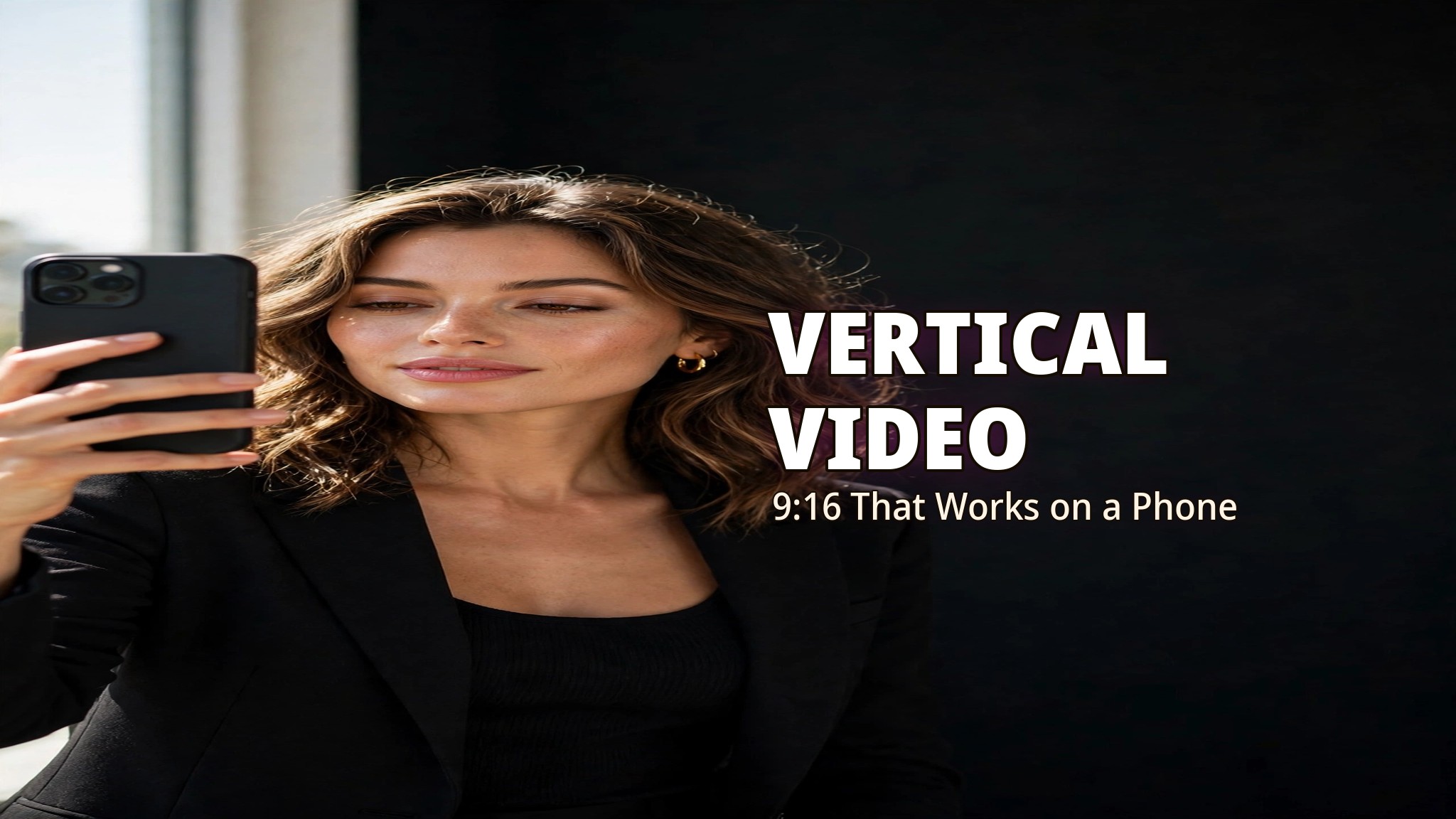
Shoot for the phone, not the cinema: one subject, face in the top third, motion that reads at arm’s length, and a loop that closes cleanly. A vertical clip that is planned vertical looks intentional; a wide clip that is cropped vertical looks like an accident — and the phone is the frame, so the plan has to start there.
In this guide
- 1. Why 9:16 is a different language, not a crop
- 2. Framing: the face lives in the top third
- 3. Motion that reads on a small screen
- 4. The vertical set: one wall, one light, one idea
- 5. Sound: the half you cannot see
- 6. The loop test: watch it three times
- 7. Export: 9:16 without the black bars
- 8. What to check before you pay
- Cost: a vertical clip costs the same as a wide one
- 9. Consent: the rule that decides everything
- FAQ
Vertical vs wide, side by side
| Wide 16:9 | Vertical 9:16 | |
|---|---|---|
| Subject | Two or three, side by side | One, centered |
| Where the eye goes | Across the frame | Down the frame |
| Motion that works | Camera moves sideways | Subject moves toward you |
| Biggest mistake | Empty middle | Cropping a wide shot |
The table is the whole argument in one place. Wide video is a stage; vertical video is a doorway. One subject walks through it, and the phone is the frame — the frame decides what fits, and what fits is one thing at a time.
1. Why 9:16 is a different language, not a crop
A wide frame is a landscape: it holds a room, a group, a horizon. A vertical frame is a portrait: it holds one person, from the head to the waist, with nowhere to hide a second idea. Cropping a wide video to 9:16 does not make a vertical video; it makes a wide video with the sides cut off, and the cut usually takes the thing that mattered — the hand, the second person, the edge of the scene.
The difference shows up in the prompt. A wide prompt says “a couple in a living room, the camera moving left”. A vertical prompt says “one woman, centered, the camera still, she leans toward the lens”. The first prompt fills a stage. The second prompt fills a doorway. And the doorway is the point, because the phone is the frame — a tall, narrow frame that rewards one subject and punishes two.
2. Framing: the face lives in the top third
In a vertical frame, the face lives in the top third. Not the middle, not the bottom — the top third, where the eye lands first when the phone lights up. Put the face there and the clip reads in the first second. Put the face in the middle and the top third is empty ceiling; put it at the bottom and the viewer scrolls past before they see it.
The rest of the frame has a job too. The middle third is the body and the gesture — the hand reaching, the shoulder turning, the dress moving. The bottom third is the ground and the context — the floor, the chair, the light coming through the window. Three thirds, three jobs, and the phone is the frame: a tall frame that tells a story from top to bottom, not from left to right.

3. Motion that reads on a small screen
Motion that works wide does not work vertical. A slow camera pan across a room is invisible on a phone: the pan takes five seconds, the phone is six inches wide, and the viewer has already scrolled. What reads on a small screen is motion toward the viewer — a lean in, a step forward, a hand reaching toward the lens. Motion that comes closer reads; motion that goes sideways disappears.
Keep the camera still and let the subject move. A still camera with a moving subject is the vertical rule, because the phone is the frame and the frame is already moving — the viewer holds it, tilts it, walks with it. A moving camera on top of a moving phone is motion sickness. A still camera, a subject who leans in, and the clip feels like someone is talking to you.
One motion per clip. A lean in and a turn and a step back is three motions, and three motions in five seconds is a blur. One motion, done well, is a clip. The second article on this site covered motion prompts in general; the rule here is narrower: in vertical, the motion comes toward the lens.
4. The vertical set: one wall, one light, one idea
A vertical set is a small set. One wall, one light, one idea — that is the whole list. A wide set needs a room; a vertical set needs a corner. A plain wall behind the subject, one warm light to the side, and one object that says something about the scene: a chair, a window, a plant. Everything else is clutter that the narrow frame will turn into noise.
The wall is the most important part. A plain wall makes the subject the only thing to look at; a busy wall makes the subject one thing among many. If the wall has a picture, a shelf, or a window, keep it at the edge of the frame, not behind the face. The face is in the top third; the wall is everywhere else, and the phone is the frame — a narrow frame that shows every distraction twice as large as it is.
Light the subject, not the room. One light, close and warm, aimed at the face and the shoulders, and the room can stay dim. A vertical clip lit like a room looks like a room. A vertical clip lit like a portrait looks like a person.
5. Sound: the half you cannot see
Sound is the half of a vertical clip you cannot see, and on a phone it is the half that decides whether the viewer stays. Most vertical clips are watched with sound on — the phone is in the hand, the ear is close — and a clip with no sound feels unfinished in a way a wide clip does not. The third article on this site covered adding music and voice to free clips; the point here is narrower: in vertical, the sound has to match the frame.
Match the sound to the motion. A lean-in gets a soft sound — a breath, a whisper, a note that arrives with the face. A step forward gets a beat that lands when the foot lands. Sound that arrives with the motion feels intentional; sound that drifts over the clip feels like a radio left on. And the phone is the frame, so the sound is the frame’s other half: one sound, one motion, one clip.

6. The loop test: watch it three times
The fourth article on this site explained loops: a five-second clip that plays forever. The vertical version of the loop test is the same, and it matters more, because vertical clips loop by default — the viewer watches the same five seconds again and again while they decide whether to stay. Watch the clip three times in a row. If the end jumps back to the start, the loop is broken. If the end flows into the start, the loop is a clip.
The fix for a broken loop is usually the same as the fix for a broken motion: one motion, ending where it began. A lean in that returns to the starting pose loops. A lean in that ends somewhere else does not. And the phone is the frame, so the loop is the frame’s promise: the same five seconds, forever, without a jump.
Three watches is the test. One watch tells you whether the clip is good. Three watches tell you whether the clip is a loop. A clip that survives three watches survives a hundred.
7. Export: 9:16 without the black bars
The most common vertical failure is not in the generation; it is in the export. A 9:16 clip exported as 16:9 with black bars on the sides is a wide video pretending to be vertical, and the phone shows it as a small picture in the middle of a black screen. Export 9:16 as 9:16: 1080 by 1920, the tall rectangle, no bars, no padding.
Check the export before you share it. Open the file on the phone, full screen, and look at the edges. If there is a black bar on either side, the export is wrong. If the clip fills the screen from edge to edge, the export is right. The export is the last step and the easiest to get wrong, because the phone is the frame — and the frame is only 9:16 if the file says so.
8. What to check before you pay
Check four things before you pay: the face is in the top third, the motion is one motion toward the lens, the set is one wall and one light, and the export is 1080 by 1920 with no black bars. Four checks, one payment, and the payment is the four.
The free tier is the place to fail. This site’s free tier lets you make video without a credit card — starting generation needs a Google sign-in — so the checks above cost nothing to run on a free clip. Pay only when the free clip passes all four checks, and the paying is the keeping.
Cost: a vertical clip costs the same as a wide one
A vertical video template costs the same as a wide one: 351 credits for a 5-second clip — roughly $7.02 on the $19.99 pack and $4.21 on the $59.99 pack — and 561 credits for an 8-second clip — roughly $11.22 on the $19.99 pack and $6.73 on the $59.99 pack. A standard image is 6 credits — roughly $0.12 on the $19.99 pack and $0.07 on the $59.99 pack — so a test still costs almost nothing. Prices checked 13 Nov 2026; the generator shows the exact cost before you run it, so the price is never a surprise.
That is why the free tier matters here: plan the clip, test the framing on a free clip, and pay for the video template only when the plan is proven. The format does not change the price, and the price does not change the format — the planning is the saving.
The free baseline still stands: a 100% free tier, no credit card required; starting generation needs a Google sign-in. Start free, and the starting is the planning.
9. Consent: the rule that decides everything
Only generate images and videos of yourself, or of fictional adults. Never generate an image or a video of a real person without their consent — not a celebrity, not an acquaintance, not a stranger. Non-consensual generation is not allowed, and a generated video is harder to take back than a photo once shared. The tool is built for your own images and fictional adults, and that boundary is absolute.
Vertical video makes the rule matter more, not less. A vertical clip is made for a phone, and a phone is made for sharing — one tap, and the clip is somewhere else. A clip made with consent is a clip you can share without fear. A clip made without consent is a clip that should never have existed. Consent is the first frame, and the first frame decides everything after it.
FAQ
Is vertical video just a cropped wide video?
No. A vertical video is planned vertical from the first word of the prompt: one subject, face in the top third, motion toward the lens. Cropping a wide video cuts off the sides and usually takes the thing that mattered.
Where should the face be in a 9:16 frame?
In the top third, where the eye lands first when the phone lights up. The middle third is the body and the gesture; the bottom third is the ground and the context.
What motion works best in vertical?
Motion toward the viewer — a lean in, a step forward, a hand reaching toward the lens. Keep the camera still and let the subject move; one motion per clip.
How do I export a vertical clip correctly?
Export 9:16 as 9:16 — 1080 by 1920, no black bars, no padding. Open the file on the phone, full screen: if there is a black bar on either side, the export is wrong.
Does a vertical clip cost more than a wide one?
No. A video template costs 351 credits for 5 seconds and 561 for 8 seconds, whatever the format. The format changes the planning, not the price.
Can I make AI porn of a real person?
No. Only generate images of yourself, or of fictional adults. Generating an image or a video of a real person without consent is not allowed.
Final verdict
Shoot for the phone, not the cinema: one subject, face in the top third, one motion toward the lens, and an export that fills the screen. A vertical clip that is planned vertical looks intentional, and the phone is the frame.