Ever thought about taking your creative work to the next level without endless hours in the studio? Modern professional post-production is all about speed and quality. With smart automation, you can change how you do tasks like trimming, color grading, and captioning.
An advanced ai porn video editor can make your workflow smoother and keep your visuals top-notch. These tools let you focus on telling your story, not getting bogged down in technical details. As the industry keeps changing, learning to use these efficient tools is key for creators who want to stay on top.
Key Takeaways
- Discover how to balance rapid production speeds with high-quality visual results.
- Learn the benefits of using automated tools for trimming and color correction.
- Understand why captioning is a vital pillar of modern content accessibility.
- Explore how smart software reduces the time spent on repetitive technical tasks.
- Gain insights into building a more efficient and professional creative workflow.
Setting Up Your Professional Post Workflow
Creating a smooth post workflow is key for handling tough video projects. A solid technical base means less time fixing issues and more time on creativity. A well-set-up workstation makes sure your software works fast, even with big files.
Hardware Requirements for Smooth Editing
Your computer needs to meet certain standards for top-notch results. Look for a multi-core processor and a dedicated graphics card for complex tasks. High-speed NVMe SSD storage is crucial for quick file access.
Here’s a table showing the best hardware for smooth editing:
| Component | Entry Level | Professional Grade |
|---|---|---|
| Processor (CPU) | 6-Core | 12-Core or higher |
| Memory (RAM) | 16GB | 32GB – 64GB |
| Graphics (GPU) | 4GB VRAM | 8GB+ VRAM |
| Storage | SATA SSD | NVMe Gen4 SSD |
Organizing Your Project Assets
With the right hardware, focus on project asset management. A clear folder structure avoids lost files and broken links. Create a main folder for each project with subfolders for different types of files.
Use consistent naming for your files. Labels with dates and tags help find assets fast. Good project asset management helps grow your production and keeps your post workflow professional.
Mastering the AI Porn Video Editor Interface
Learning the interface of your ai porn video editor can change your creative game. Knowing the layout helps you focus on your vision, not tech issues. When you’re comfortable, you work faster.
Navigating the Timeline and Workspace
Good timeline navigation is key for any project. Modern video editing software lets you customize your space. Arrange your tools so you can find them quickly.
Keep your area tidy by closing unused panels. This reduces distractions and keeps you focused. Learning shortcuts can save you a lot of time.
Utilizing AI-Powered Automation Features
The best part of a ai porn video editor is its automation. It handles boring tasks, giving you time for creativity. These tools work while you focus on the edit’s flow.
Automated Scene Detection
Manual clip cutting is slow and tiring. Automated scene detection makes quick, accurate cuts. It’s a huge time-saver for long videos.
Smart Object Tracking
Smart object tracking applies effects with precision. It tracks subjects automatically, saving you from manual adjustments. This keeps your project looking consistent, even with moving subjects.
| Task Type | Manual Method | AI-Powered Method |
|---|---|---|
| Scene Cutting | Frame-by-frame review | Instant auto-detection |
| Subject Masking | Manual keyframing | Smart object tracking |
| Workflow Speed | Slow and repetitive | Fast and efficient |
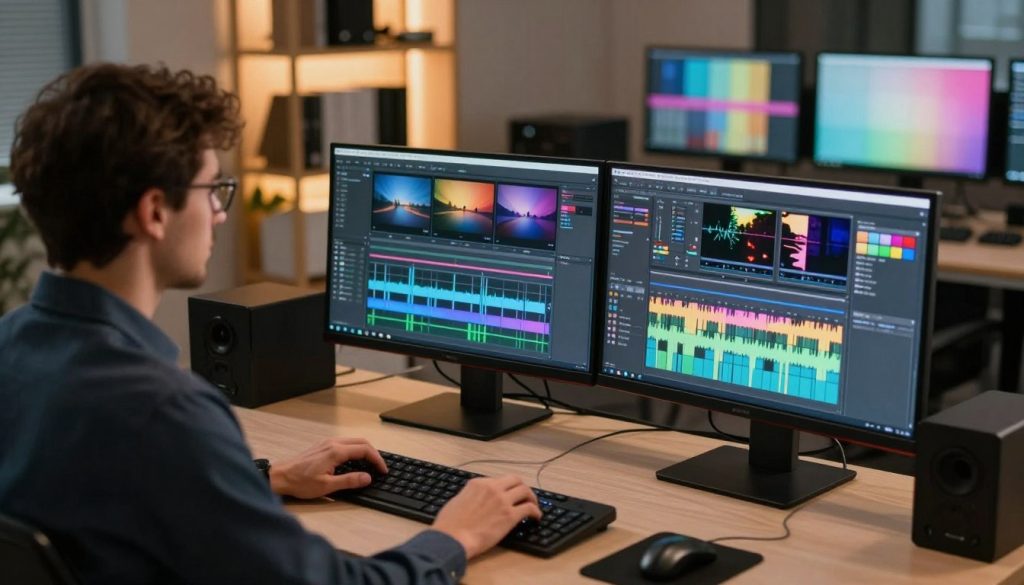
Precision Trimming and Cutting Techniques
Your skill in handling footage greatly affects your video’s quality. To achieve professional post-production, you need to trim and pace carefully. This ensures your video stays engaging and easy to follow.
Performing Rough Cuts for Pacing
First, you arrange your clips in a way that tells your story. This is like creating the basic structure of your project. It’s about getting the flow right, not perfecting every detail yet.
At this stage, focus on making the story feel natural and the right speed. Once it feels good, you can start making more precise changes.
Refining Transitions and Frame Accuracy
After setting your rough cuts, focus on the technical aspects. Keeping frame accuracy is key when fine-tuning transitions. A single misplaced frame can break the viewer’s connection.
Zoom in on your timeline to check the exact clip connections. Perfectly aligned transitions make your video smooth and polished. This level of detail is what makes professional content stand out.
Removing Unwanted Footage Efficiently
To keep your story tight, you must cut out unnecessary parts. Removing unwanted footage keeps your narrative focused and engaging. Look for anything that slows down or distracts from your main point.
Mastering these cutting techniques gives you control over your professional post-production process. Remember, frame accuracy is crucial for a sharp final product. Cutting out the unnecessary lets your best content shine.
Advanced Color Grading for NSFW Content
Color grading is key to making your footage look professional. It’s about enhancing the visuals so every frame impresses your audience. This turns raw footage into a polished and immersive experience.
Adjusting Skin Tones and Contrast
Getting human subjects to look natural is crucial. Skin tone correction means adjusting red, green, and blue channels for a realistic look. Use scopes to avoid over-saturation or dullness in skin tones.
Contrast is also vital for depth in your scenes. By tweaking shadows and highlights, you create a dynamic range. This makes your subjects stand out against the background, enhancing your visual quality.
Applying Cinematic LUTs for Visual Consistency
Cinematic color grading is essential for setting a mood. Look-Up Tables, or LUTs, apply complex color profiles easily. They ensure your footage looks consistent, even under different shooting conditions.
Consistency is key in professional editing. A uniform grade makes your project feel like a single story. Try different LUTs to find your brand’s unique style.
Correcting Lighting Discrepancies
Lighting can change during a shoot, causing uneven exposure. Use keyframes to adjust exposure and white balance smoothly. This keeps transitions between shots seamless and professional.
When fixing lighting, always focus on skin tone correction. The human eye is very sensitive to color changes in faces. Matching brightness and color temperature ensures smooth transitions, making your work stand out.
Implementing Automated Captioning Tools
Modern video production needs accessibility features to reach more people. Automated captioning makes sure your message is clear, no matter the viewer’s setting or audio.
Generating Accurate Transcripts Automatically
Today’s AI tools can turn your audio into text in seconds. They study speech patterns to give you top-notch results with little editing needed.
Automated captioning cuts down on tedious work in post-production. It lets you spend more time on creative editing, not just typing out every word.
“Accessibility is not just a feature; it is the foundation of a truly global and inclusive digital experience.”
Customizing Caption Styles and Placement
After your text is ready, make it look good with your brand in mind. Most editors let you change font sizes, colors, and background opacity for better reading.
Where you place your captions is also key. Move them to the lower third or center to keep important visuals clear.
Syncing Text with Audio Cues
Getting the timing right is crucial for a pro video. Your captions must match the spoken words perfectly to keep viewers engaged.
Automated captioning software uses waveform analysis to sync text with audio. This ensures your captions appear and disappear at the right time, giving your viewers a smooth experience.
Optimizing Your Editor NSFW Video Export Settings
Your export settings are key to getting your video to the viewer. The final output affects how your video looks and plays. Setting up your editor nsfw video right ensures it looks great everywhere.
Selecting the Right Codecs for Quality
Choosing the right codec is crucial for quality. H.264 is the top choice for most devices. H.265 is better for high-res files. Pick these for the best video quality.
“Quality is not an act, it is a habit.”
Balancing File Size and Resolution
It’s important to balance file size and resolution. 4K looks amazing but can be huge. Here’s how to manage:
- Use variable bitrate (VBR) for smaller files in simple scenes.
- Choose a resolution that fits your audience’s devices.
- Adjust the frame rate for smooth motion without big files.
Preparing Files for Web Distribution
For web, your files need to play on any device. MP4 is the best format for this. Make sure your content distribution is smooth and professional.
Check your video before uploading. This ensures it looks perfect for your viewers.
Managing File Organization and Storage
Keeping your files organized makes your post workflow smooth. It saves you time by avoiding the hassle of searching for missing clips. A well-organized system is key for any professional editor who values their time and data.
Implementing Naming Conventions
Being consistent is crucial for a clean project. Use a standard naming system for all your assets, like raw footage and final exports. Labels with dates or project codes make files easy to spot.
For instance, naming a file “2023-10-12_ProjectName_Scene01_Raw” is better than “Video1.” This way, you can sort files by date or scene easily. Always skip special characters and spaces to avoid compatibility problems.
Backing Up Your Project Files
Every editor’s worst fear is losing their work. A solid backup plan is essential to prevent data loss. The 3-2-1 backup rule is the standard for a safe post workflow.
“For every minute spent organizing, an hour is earned.”
This rule means having three copies of your data on two different types of media, with one off-site. Cloud storage is great for protecting your key files. Automating backups keeps your work safe and recoverable.
| Storage Type | Best Use Case | Reliability | Speed |
|---|---|---|---|
| Internal SSD | Active Editing | High | Very Fast |
| External HDD | Long-term Archive | Medium | Moderate |
| Cloud Storage | Off-site Backup | High | Depends on ISP |
Troubleshooting Common Post-Production Issues
Even experienced editors sometimes hit technical roadblocks. These issues can stop your creative flow. Knowing how to quickly solve them is key to being a pro.
Using your video editing software well means staying calm when problems arise.
Resolving Syncing Errors
Audio and video not syncing is a big problem. It often happens when your footage’s frame rate doesn’t match your project settings. Always check your sequence settings before editing to avoid this.
If audio and video get out of sync, try clearing your media cache. Sometimes, a bad cache file causes playback issues. If that doesn’t work, manually adjust the audio to match the video.
Fixing Rendering Glitches
Rendering problems can be very stressful. If you get a crash or see weird visuals during video rendering, check your hardware settings. Switching between software and GPU modes can fix issues.
Another common problem is using the wrong codec or too many effects. Try breaking your project into smaller parts or making a short test clip. Keeping your workspace clean and updating drivers helps avoid these problems.
Conclusion
Professional video production mixes technical skills with creative vision. You now know how to manage your assets and improve your cuts. You can use software like Adobe Premiere Pro or DaVinci Resolve to do this.
Keeping a steady workflow is key to quality. Even small changes in color or captions can boost viewer interest. Make sure to focus on these details to make your content pop.
Don’t be afraid to try new things. Experiment with lighting or pacing in your next project. This will help you grow as an editor.
Stay up-to-date with new software and hardware. Creators’ tools change fast, offering new ways to work. Keep exploring to improve your work for your audience.
FAQ
Why is it essential to establish a standardized post workflow for your projects?
A standardized post workflow is key for professional content creation. It makes editing in Adobe Premiere Pro or DaVinci Resolve easier and faster. This way, every project stays high-quality and true to your vision.
What hardware upgrades will most significantly improve my experience as an editor nsfw video professional?
For smooth editing, get a strong GPU like the NVIDIA GeForce RTX 4090. Also, have at least 32GB of fast RAM. An NVMe M.2 SSD, like the Samsung 990 Pro, makes your project files load quickly.
How can an ai porn video editor streamline the more tedious aspects of production?
An ai porn video editor uses smart tech to do the boring stuff for you. Tools like Runway or Topaz Video AI can detect scenes and change backgrounds easily. This lets you focus on making your edit look great.
What is the best method for correcting skin tones and lighting in NSFW content?
For natural skin tones, you need to fine-tune your color grading. Use tools like the Lumetri Color panel in Premiere Pro or DaVinci Resolve’s color wheels. Start with primary color correction to fix lighting issues between shots.
How do I ensure my final export is optimized for web distribution platforms like OnlyFans or Fansly?
For web distribution, use H.264 or H.265 codecs. These keep your video clear while keeping file size down. Make sure your bitrate is high enough to avoid quality loss on screens.
What steps can I take to prevent data loss and keep my project assets organized?
Start with a clear naming system for your files. Store your footage on a dedicated drive and back it up on a Synology NAS or cloud service. This keeps your work safe from loss.
How can I troubleshoot common rendering glitches or audio-video sync issues?
Sync issues often come from different frame rates or sample rates. Transcode your footage to a fixed frame rate before editing. For rendering problems, try clearing your Media Cache or change your renderer to CUDA.