Ever wondered why some digital chats feel real, while others seem fake right away? It’s often because of the way people move and the timing. If the interaction looks forced, like a bad rhythm or awkward talk, it can ruin everything.
Creating scenes with many characters is key in today’s digital world. By focusing on fluid blocking and authentic chemistry, you can make your work better than others. This guide will show you how to handle complex scenes that viewers will love.
Improving your synchronization skills can make your ai porn video duo scenes shine. Find out how to mix static images with moving stories to keep viewers hooked.
Key Takeaways
- Understand the impact of rhythm and timing on viewer perception.
- Learn to identify and correct forced interactions in digital content.
- Master advanced blocking techniques to improve character chemistry.
- Discover how to maintain flow across complex multi-character setups.
- Elevate your production quality to meet modern standards of realism.
Mastering the Fundamentals of AI Porn Video Duo Scenes
To make top-notch ai porn video duo scenes, you need to know your limits. When you start with more than one character, things get a lot more complex. You have to mix your creative ideas with what your tools can do to get good results every time.
Defining the Scope of Multi-Character Generation
Working with more than one character changes how you see your digital space. You’re not just focusing on one person anymore. You’re dealing with the interplay between two or more. This means you need a clear story to keep things simple and focused.
It’s key to know where each character should be in the picture. This helps avoid mistakes and keeps your scenes looking sharp. This basic step is crucial for keeping your ai porn video duo scenes looking great.
“Technical precision is the silent partner of creativity; without a stable foundation, even the most inspired vision will falter during the rendering process.”
Essential Software and Model Requirements
You’ll need strong software to handle the extra work of multiple characters. Most people use Stable Diffusion with special tools for managing many subjects. Look for models that can handle high detail and precise editing to keep your characters clear.
Your computer’s setup is the core of your work. You need lots of VRAM to avoid problems when working with many characters at once. Here’s a table showing the best computer setups for this:
| Hardware Component | Entry Level | Professional Tier |
|---|---|---|
| GPU VRAM | 8GB – 10GB | 16GB – 24GB |
| System RAM | 16GB | 32GB+ |
| Rendering Speed | Moderate | High-Efficiency |
| Model Support | Standard SD 1.5 | SDXL / Flux |
Matching your software with your computer’s power makes your work smoother. Make sure your software can handle many characters well for the best results.
Strategic Blocking for Multi-Character Compositions
Strategic blocking is key for believable scenes in AI videos. It’s about how characters use space. This makes the scene feel real.
Establishing Spatial Relationships Between Characters
To make characters seem real, define their space. Proximity is key. Characters should look like they’re on the same level to avoid looking cut out.
When characters move, their space should stay the same. If one reaches out, the other must be close. This makes the scene feel real and not accidental.
Managing Depth of Field and Camera Angles
Using the camera helps control what the viewer sees. A shallow depth of field blurs the background. This makes the characters’ actions more focused.
Choosing the right camera angle adds to the scene’s impact. A low angle makes characters seem stronger. A high angle shows vulnerability. Try different angles to guide the viewer’s attention.
| Camera Angle | Visual Impact | Best Use Case |
|---|---|---|
| Eye-Level | Neutral and realistic | Standard dialogue scenes |
| Low Angle | Powerful and imposing | Dominance-based interactions |
| High Angle | Submissive or vulnerable | Intimate or emotional moments |
| Dutch Angle | Tense and disorienting | High-energy or chaotic scenes |
Utilizing Rule of Thirds in Duo Scenes
The rule of thirds helps balance two characters in a frame. Place them on the grid lines or intersections. This makes the scene feel natural and balanced.
In duo scenes, put one character on the left and the other on the right. This creates dynamic tension. It makes the viewer move their gaze between the characters. Learning this grid system improves your multi-character scenes.
Developing Authentic Chemistry Through Prompt Engineering
The secret to creating real AI scenes is in the emotional bond between subjects. While it’s key to design each character well, the energy exchange between them makes a scene feel real or fake. You need to go beyond just physical looks to capture the true essence of human interaction.

Chemistry reads test an actor’s ability to create authentic, dynamic relationships that convince both casting and future audiences.
Crafting Descriptive Prompts for Interpersonal Dynamics
To get top-notch results, your prompts must clearly show the relational intent of the characters. Instead of just listing looks, describe the action and feelings of the characters. Use active verbs that show movement and connection between them.
Here are some tips to make your prompts better:
- Proximity cues: Use terms like “leaning into,” “shoulder-to-shoulder,” or “intimate distance” to force the AI to place characters closer together.
- Shared focus: Direct the gaze of both characters toward each other to establish a clear line of sight and mutual interest.
- Dynamic verbs: Incorporate words like “interacting,” “responding,” or “synchronized” to influence the AI’s interpretation of the scene.
Balancing Character Traits for Visual Cohesion
Visual cohesion is key when you want two characters to look like they belong together. If their looks clash, the chemistry illusion breaks. Aim for a unified aesthetic that ties them together.
To keep this balance, apply consistent style to your entire prompt. For example, if you set one character’s lighting, make sure the other has the same. This avoids the “pasted-on” look that often happens with multiple characters.
Focus on these key elements to ensure your characters look like a matched set:
- Color Palette: Use consistent color grading terms to ensure both characters share the same light temperature.
- Texture Matching: Apply similar skin detail descriptors to both subjects to avoid jarring differences in resolution or style.
- Style Consistency: Use the same artist or engine-specific keywords for both characters to keep the rendering style identical.
Advanced Sync Techniques for Duo AI Porn
Creating duo AI porn that looks real is all about how characters move together. You need to understand how motion vectors work in your setup. Entrainment, or the way motion and sound work together, is key to making your scenes look real.
Aligning Motion Vectors Across Multiple Subjects
To make your characters seem like they’re moving together in real-time, you must align their motion vectors perfectly. Motion vectors show how pixels move between frames. By syncing these vectors, you avoid the jarring look that’s common in lower-quality videos.
“True synchronization is not just about timing; it is about the fluid, unified intent of the subjects within the frame.”
Managing Frame-by-Frame Consistency
Keeping the scene stable frame by frame is crucial for top-notch duo ai porn. You need to keep character features the same in every frame to avoid any unwanted changes. Using tools to lock character identity during movement helps keep the scene looking professional.
- Use temporal denoising to smooth out jittery transitions.
- Apply consistent seed values to keep character textures stable.
- Monitor the frame rate to ensure smooth playback during complex interactions.
Troubleshooting Desync Issues in Complex Movements
Even with careful planning, complex movements can sometimes cause desync issues. If a character seems to be drifting or losing connection, check your keyframe placement. Refining your prompt weights during these parts often fixes the problem, letting the AI re-establish the interaction.
If problems still exist, try breaking the scene into smaller parts. Render each part separately and then put them together. This method lets you control the final look better. It ensures your duo ai porn stays polished and clear from start to finish.
Executing Complex Group Choreography
Creating group choreography needs you to balance space and character. As scenes get more complex, so does your AI video work. You must see the scene as a system of systems, spreading information evenly among characters.
Layering Characters in High-Density Scenes
In crowded scenes, layering is key to avoid mess. By focusing on each character’s movement, you keep the AI from mixing them up. This technical layering helps you control the story, even with many characters in one place.
Use depth of field to keep subjects apart from the background. This stops the AI from mixing up characters. Good layering is crucial for group choreography in AI videos.
Maintaining Individual Character Identity in Groups
Keeping each character’s look unique is tough in big groups. Use special prompts for each to stop the AI from mixing them. Consistent character LoRAs or images help keep each character’s look distinct.
Managing Overlapping Limbs and Physical Contact
When characters touch, it can make limbs look wrong. Use inpainting masks to show where each body is. This stops the AI from seeing them as one thing.
| Strategy | Primary Benefit | Complexity Level |
|---|---|---|
| Layered Masking | Prevents limb merging | High |
| Vector Isolation | Maintains motion flow | Medium |
| Prompt Weighting | Preserves identity | Low |
These strategies help you create smooth group choreography. Always check that contact points are clear in the final version for a clean look.
Refining Lighting and Texture Consistency
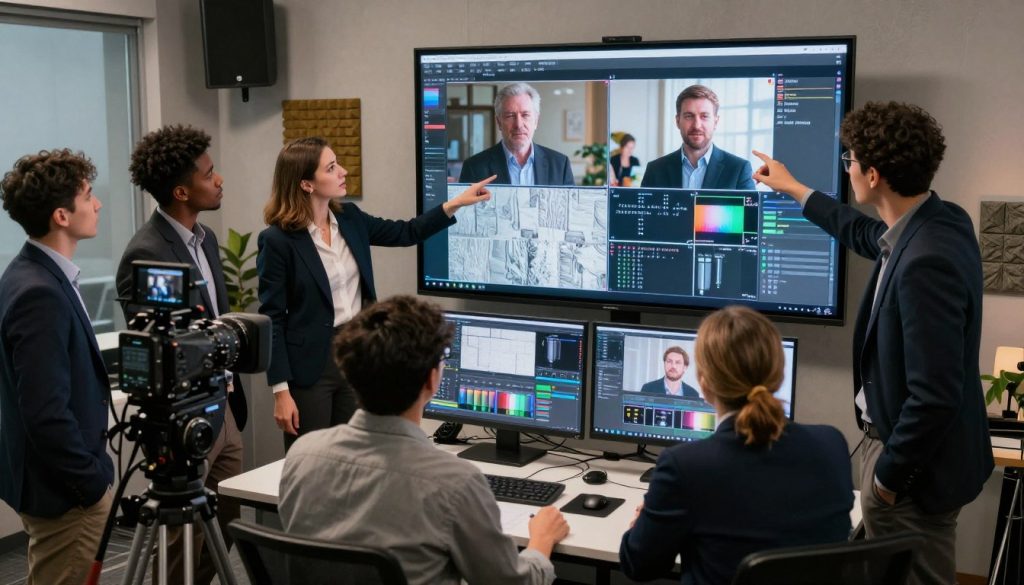
Lighting consistency is key to making your characters seem like they belong together. Without it, your multi-character scenes might look like they were made by different artists. Getting visual cohesion is what makes AI videos look professional.
Unified Lighting Setups for Multiple Subjects
To create a shared atmosphere, define a global light source in your prompt. Use terms like “cinematic rim lighting” or “soft studio key light” to guide the AI. This way, all characters will be lit equally, avoiding the look of some being too bright or too dark.
“Lighting is the language of film; it tells the viewer where to look and how to feel about the space they are inhabiting.”
Also, use environment maps or background-matching prompts to keep your subjects grounded. By setting the ambient color, like “warm golden hour glow,” you ensure all characters are under the same light. This unified approach saves you from a lot of editing work later.
Matching Skin Tones and Textures Across Characters
Keeping skin tones consistent is a big challenge in complex scenes. When characters look different, the scene’s illusion is broken. Use consistent LoRA weights or reference images with similar textures to help.
If skin tones don’t match, try changing seed values or applying a global color grade. A consistent color palette across all subjects makes skin tones and shadows look natural. This focus on detail turns a basic generation into a high-quality video.
Iterative Workflow for Polished Performances
The secret to top-notch AI video is the careful touch-up after the first render. Think of your first version as a draft, not the final product. By following a systematic, iterative workflow, you can turn raw footage into a smooth visual experience.
Using Inpainting to Fix Interaction Glitches
Even top models can have glitches or awkward character interactions. Inpainting is your go-to for fixing these issues without redoing the whole scene. Just mask the glitchy area and ask the AI to redo that part, keeping the rest of your scene intact.
For the best results, follow these steps for manual fixes:
- Isolate the frame: Find the exact moment when the interaction goes wrong.
- Mask precisely: Use a soft brush to cover just the glitch, letting the AI blend new pixels with the scene.
- Iterate with control: Adjust your denoising strength to keep the look consistent with the rest of the scene.
“The beauty of modern AI tools is the ability to treat video like a canvas, where every frame can be refined until it matches your exact creative vision.”
Upscaling and Post-Processing for Final Output
After fixing glitches, the next step is to boost the video’s visual quality. AI output often needs sharpening for today’s screens, making upscaling crucial. Special software can increase resolution, sharpen textures, and reduce noise.
But it’s not just about making it bigger. You also need to focus on color grading and motion smoothing for a unified look. A light grain or subtle color tweak can help blend different character generations. This final touch ensures your work looks professional and cinematic, perfect for any high-resolution format.
Common Pitfalls and How to Avoid Them
Creating duo ai porn is all about paying attention to details and solving problems quickly. Even with the best plans, technical issues can pop up. Spotting these problems early helps you fix settings before wasting time.
Correcting Morphing and Distortion Errors
Morphing happens when AI mixes two characters in one frame. To avoid this, adjust your denoising strength carefully. Too much denoising can mess up the original shape, causing characters to blend.
Stable seeds for the first frames help a lot. They give the AI a steady base, cutting down on shape changes. Make sure your prompts are balanced so characters don’t mix.
Solving Character Swapping Issues
Character swapping is a big problem in duo ai porn. It occurs when AI gets the characters mixed up, often because they look too alike. Use special LoRA models for each character to keep them distinct.
Regional prompting or masking tools also help. They let you define areas for each character, keeping them separate. This is key for keeping your duo ai porn project clear and professional.
| Common Error | Primary Cause | Recommended Fix |
|---|---|---|
| Morphing | High Denoising Strength | Lower Denoising Value |
| Character Swap | Overlapping Prompts | Use Regional Masking |
| Distortion | Unstable Seed | Lock Seed/Use ControlNet |
| Color Bleed | Shared Style Weights | Separate LoRA Training |
Optimizing Hardware and Rendering Pipelines
Getting smooth results in complex scenes relies on your rendering pipeline setup. With group choreography projects, the work load goes up a lot. You need to match your hardware with the AI generation needs to keep quality high.
Managing VRAM for Multi-Character Generation
Video memory, or VRAM, is key when working with many subjects at once. Each character takes up a lot of memory. If you use too much, your GPU might crash. Efficient memory management helps avoid these problems.
To get the most out of your setup, try model offloading or smaller batch sizes at first. Lowering the base generation resolution helps with more complex group choreography. Always keep an eye on VRAM to see what’s using the most.
Streamlining Render Times for Long-Form Content
Creating long videos needs a fast workflow without losing quality. Use caching strategies for static parts to speed up. This lets your system focus on the moving parts.
Breaking your project into smaller parts helps too. This way, your group choreography stays smooth and consistent. With the right hardware and export settings, you can keep up a professional pace and quality.
Conclusion
Mastering duo and group scenes in AI video generation is a mix of technical skill and creative thinking. You now have the tools to handle complex scenes. This includes managing blocking, chemistry, and synchronization.
Your ability to create engaging performances comes from being open to improvement. Use Stable Diffusion or ComfyUI to refine your work. Each try gets you closer to professional results that connect with your audience.
Explore new lighting setups and motion vectors to push AI content limits. Your hard work in learning these advanced techniques will make your work stand out. Keep pushing the limits of your hardware for more creative freedom.
Share your work with others to get new ideas on your character setups. The world of generative media is always changing. By staying involved, you’ll keep up with the latest technology. Start your next project today and use these tips to bring your vision to life.
FAQ
What software is essential for producing high-quality duo ai porn scenes?
For top-notch results, use Stable Diffusion with ComfyUI or Automatic1111. These tools are great for keeping characters consistent and handling complex scenes.
How can you establish realistic chemistry between characters in AI generation?
To create real chemistry, focus on verbs and phrases in your prompts. Describe how characters interact and look at each other. This makes the scene feel like a single unit, not two separate figures.
What are the best techniques for managing complex group choreography?
Use a layering method for group scenes. Assign prompts to different parts of the frame with tools like Regional Prompter. This keeps each character’s identity clear, even when they’re close together.
How do you prevent motion desync and visual artifacts in duo scenes?
Mastering motion vectors and frame-by-frame consistency is key. Tools like AnimateDiff help align movements. For desync issues, adjust motion scale or use TemporalKit for smooth interactions.
What hardware is required to render multi-character AI content efficiently?
High-density scenes need a lot of VRAM. An NVIDIA GeForce RTX 4090 with 24GB VRAM is ideal. It handles complex scenes without slowdowns or errors.
How can you maintain consistent lighting and skin tones across multiple characters?
Use a unified lighting setup in your prompts. Terms like “cinematic rim lighting” help. For skin texture, use Lora models trained on skin. This ensures all characters look like they’re in the same space.
What is the best way to fix interaction glitches or morphing limbs?
Use an iterative workflow with Inpainting. Mask out errors in Stable Diffusion or Adobe Photoshop. Then, regenerate with higher denoising strength to fix the issue.
How do camera angles and depth of field affect multi-character compositions?
Strategic blocking is crucial. Use prompts for camera angles like “low angle” to set spatial relationships. Adjust depth of field to focus attention on the main interaction.