Ever thought if your digital media really shows off your display’s full potential? Many creators face a challenge to match the high detail today’s viewers expect.
Getting good at the technical side is key to making lower-quality assets look top-notch. You need to know the difference between native captures and hd upscaling to get the best look.
This guide helps you tackle the tough parts of modern production. Whether it’s an ai porn video 4k or a standard 4k ai video, a clear workflow keeps your work looking sharp and bright.
Key Takeaways
- Distinguish between native resolution and post-production enhancement techniques.
- Learn the essential steps to build a professional-grade production pipeline.
- Understand how to optimize assets for modern high-definition displays.
- Identify the core benefits of using automated software for visual clarity.
- Master the workflow required to maintain quality during the conversion process.
Understanding the Fundamentals of AI Porn Video 4K Upscaling
The move to high-resolution standards has made advanced image processing key for creators. Industries like film and marketing now need ai porn video 4k outputs. Knowing these basics is crucial for keeping up in a competitive digital world.
Defining the Upscaling Process
Upscaling is more than just making a small image bigger. It’s about increasing resolution and reconstructing missing visual details. Unlike old methods, new techniques use smart data interpolation.
This ensures your work looks clear and sharp, as viewers expect today. It’s especially important for old footage that needs to look good in 4K or 8K. Learning this skill lets you turn old content into a top-notch ai porn video 4k asset.
The Role of Neural Networks in Video Enhancement
Neural networks are the heart of modern video improvement. They connect low-quality sources to high-definition results. These systems look at each frame to guess missing pixel data, making images clearer.
Unlike old filters, neural networks learn from big datasets. They spot and keep important edges, giving a cleaner, more natural look. Using these tools means teaching your software to make an ai porn video 4k that meets top standards.
Assessing Your Source Material for HD Upscaling
The quality of your final 4K output starts with your source material. Before starting a long rendering process, check the technical health of your files. Good preparation is key to successful hd upscaling, avoiding the enlargement of existing flaws.
Identifying Compression Artifacts
Most generative AI assets are made at 480p or 720p resolutions. These files often hide issues like macroblocking, ringing, and color banding. These problems are not seen on smaller screens but become clear when scaling.
Look for pixelated edges and muddy textures in dark areas. If your footage is heavily compressed, a light denoising pass might be needed. This helps the AI sharpen the image without making noise worse.
Determining Optimal Frame Rates for Upscaling
Frame rate consistency is as important as resolution. Irregular frame rates can lead to stuttering or ghosting after enhancement. Make sure your project settings match the native frame rate of your clips for smooth motion.
High-motion scenes need extra care to avoid motion blur distortion. Locking your frame rate early helps the AI work with a stable reference. This is crucial for a professional 4K finish.
| Issue Type | Visual Symptom | Impact on Upscaling |
|---|---|---|
| Macroblocking | Blocky, square patterns | High (Distorts textures) |
| Color Banding | Visible gradients | Medium (Creates artifacts) |
| Low Frame Rate | Choppy motion | High (Requires interpolation) |
| Source Resolution | Soft, blurry edges | Low (Ideal for hd upscaling) |
Setting Up Your Hardware for Efficient Processing
High-quality AI upscaling needs more than just software. It requires a well-balanced hardware setup. When you use complex algorithms to rebuild frames, the right parts are crucial. Efficiency is the key to avoid system crashes and bottlenecks.
GPU Requirements for AI Rendering
The graphics processing unit is the heart of AI tasks. It handles intense math operations. For example, upscaling a 10-second 720p video to 4K with FlashVSR takes about 52 seconds on modern hardware.
“The bottleneck in modern video production is rarely the software, but rather the inability of the hardware to keep pace with the massive data throughput required for real-time AI reconstruction.”
To keep rendering stable, check these hardware benchmarks:
- VRAM Capacity: Aim for at least 8GB to 12GB of dedicated video memory.
- Compute Power: Choose modern architectures with dedicated tensor cores.
- Thermal Management: Make sure your GPU has good cooling to avoid overheating during long renders.
Memory and Storage Considerations
System memory and storage speed are key for handling big data. High-resolution files need fast data transfer to avoid delays. A high-speed NVMe SSD is essential for quick loading and saving of 4K files.
| Component | Minimum Requirement | Recommended for 4K |
|---|---|---|
| RAM | 16GB | 32GB or higher |
| Storage | SATA SSD | NVMe Gen4 SSD |
| GPU VRAM | 6GB | 12GB+ |
Choosing the right hardware cuts down render times and boosts output stability. A good balance of RAM and fast storage makes AI tasks smoother. Always check your power supply can handle your components’ peak load during long renders.
Step One: Preparing Raw Footage for AI Enhancement
Getting your video ready for AI enhancement is key. It’s the foundation of a professional workflow. This ensures your final video looks sharp and clear. Organizing your footage well makes your hd upscaling work more efficient.
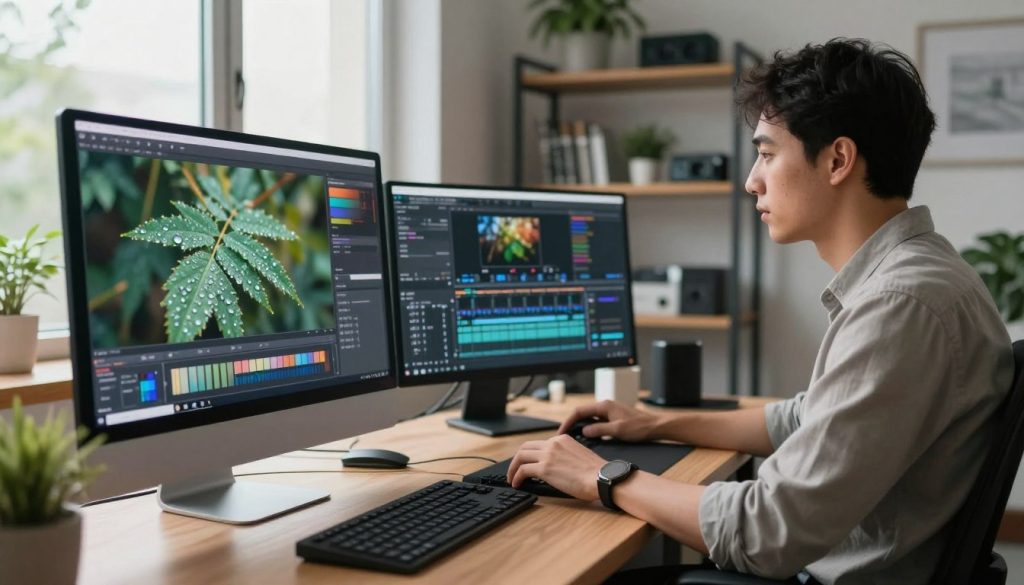
Trimming and Organizing Clips
First, clean up your source material. Remove unnecessary footage to save AI processing power. Keeping your files organized helps your workflow run smoothly.
Here are some tips for organizing your project:
- Create a folder just for raw, unprocessed assets.
- Use the same naming for all clips to avoid mix-ups.
- Get rid of any redundant or damaged segments before using them.
“Organization is the silent partner of every successful digital restoration project; without it, even the best AI models will struggle to deliver consistent results.”
Converting Formats for Compatibility
After trimming, make sure your clips are ready for AI tools. Convert them to high-bitrate formats to keep colors true. This step avoids color shifts and compression issues seen in lower-quality files.
Picking the right codec is crucial for hd upscaling. Use uncompressed or high-bitrate formats to give AI models the best data. This meticulous preparation reduces file corruption risks and ensures a smooth transition to your enhanced 4K video.
Step Two: Selecting the Right AI Model for Video Clarity
Choosing the right AI model is key to making high-quality 4k ai video. The quality of your final video depends on the AI engine you pick. Whether you want sharp details or smooth motion, the model you choose affects your video’s look.
Comparing Topaz Video AI vs. DaVinci Resolve Super Scale
Topaz Video AI and DaVinci Resolve Super Scale are often compared. Topaz is known for its advanced algorithms that add a cinematic touch. The Topaz Astra Creative model is great for fixing AI issues, making videos look smooth and consistent.
DaVinci Resolve, on the other hand, is perfect for editors who need fast color grading. When choosing between them, consider these points:
- Topaz Video AI: Great for detailed restoration and texture recovery.
- DaVinci Resolve: Best for a professional color grading workflow.
- Efficiency: Think about your computer’s VRAM, as some models need a lot to work well with 4k ai video.
Choosing Between Motion-Based and Detail-Based Models
Choosing the right AI model depends on what you want to achieve. Motion-based models keep your video stable, preventing the shaky look of low-quality upscales. They analyze each frame to ensure smooth playback.
Detail-based models, on the other hand, add texture to still or slow-moving shots. They improve edge definition and surface grain, making HD clips look like 4k ai video. Knowing these differences helps you choose the best model for your project.
Step Three: Configuring Native Upscaling Settings in Software
Adjusting your software settings is key to turning raw footage into a high-definition masterpiece. After picking your AI model, you must tweak your settings to keep the visuals sharp. This step is crucial for hd upscaling, as it affects how your software handles the source material.
Adjusting Resolution Scaling Parameters
When scaling, finding the right balance is essential. Too much resolution can make the image look fake. Adjust the scaling sliders to keep details sharp and the image natural.
Getting hd upscaling right means controlling these settings carefully. If your footage looks too soft, try increasing detail retention. If it’s too harsh, reduce sharpening to keep it cinematic.
Fine-Tuning Anti-Aliasing Filters
Jagged edges can ruin the viewing experience. Anti-aliasing filters help smooth these out, making the image cleaner. Watch the preview closely while adjusting these filters to avoid blurring textures.
Properly set filters keep your hd upscaling free from digital flaws. By fine-tuning these settings, you ensure your project looks professional. Paying attention to these details will make your video smooth and high-quality, perfect for any screen.
Step Four: Implementing Post-Pipeline Sharpening and Denoising
To get a cinematic look in your 4k ai video, you need to fine-tune the final image. This stage is all about making sure your video looks top-notch. By tweaking the last details, you can turn raw footage into professional content.
Applying Temporal Denoising Techniques
When you upscale your footage, it might get grainy or flicker. Temporal denoising helps by looking at many frames to find and fix these issues. This keeps your 4k ai video looking smooth and steady.
Be careful when using these filters to avoid losing important textures. Start with a small amount and add more until the noise goes away. This way, you keep your video looking good while cleaning up the background.
Balancing Sharpness Without Introducing Noise
Sharpening tools are key for adding detail, but they can make your video look fake if not used right. You need to find the perfect balance to make your 4k ai video sharp without digital flaws. Focus on enhancing edges rather than changing the overall contrast.
Here’s a table to help you manage these settings for the best results:
| Technique | Primary Benefit | Risk Factor |
|---|---|---|
| Temporal Denoising | Removes flicker | Softens fine detail |
| Unsharp Masking | Increases edge definition | Adds halo artifacts |
| Luma Sharpening | Enhances texture | Increases visible grain |
Always check your work on a high-resolution screen to make sure it looks great. By carefully adjusting these settings, you can make your 4k ai video look professional for top-quality distribution.
Step Five: Managing Color Grading and Bitrate During Export
Managing your color profile and bitrate is key in your 4K production workflow. The AI enhancement process fixes the visuals, but your export settings package it for viewers. Precision at this stage is crucial to avoid color banding and compression artifacts.
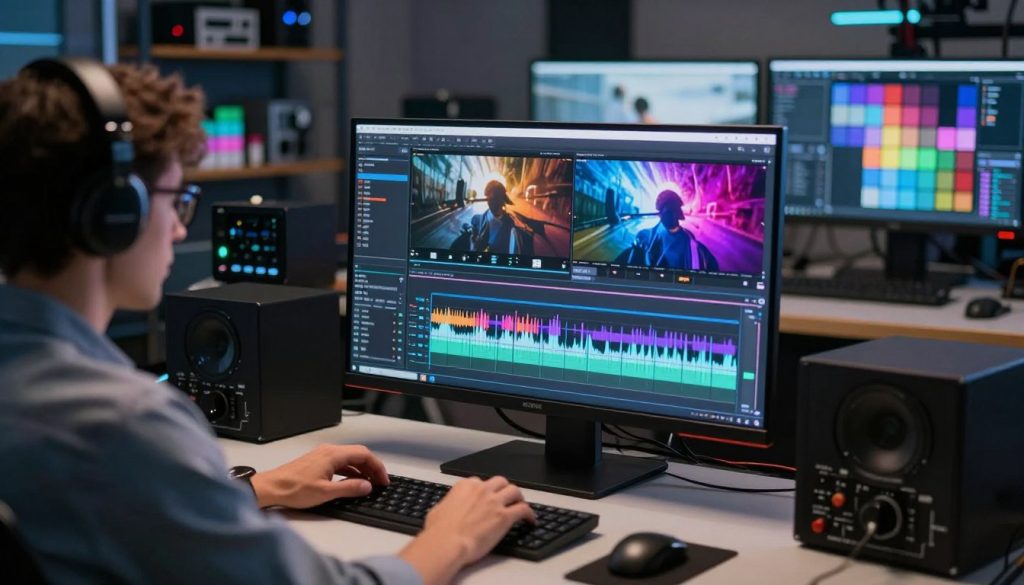
Maintaining Color Fidelity in 4K
Color accuracy is essential for HDR displays. Make sure your color space settings, like Rec. 2020 or P3, match your project needs. Proper color management keeps deep blacks and vibrant highlights intact during the final render.
Incorrect bit depth can cause banding in gradients, like skies or shadows. Always export in 10-bit or higher if possible. This extra data helps maintain smooth transitions in your 4K frame.
Selecting the Best Codecs for Final Output
Choosing the right codec balances file size and visual quality. H.265 (HEVC) is the industry standard for professional 4K workflows. It offers great compression efficiency without losing detail. For maximum quality, Apple ProRes is the best choice.
Consider the target playback device when choosing a codec. ProRes is great for high-end production, while H.265 works well with streaming platforms and smart TVs. Always check your bitrate settings to support the complexity of your 4K footage.
| Codec | Best Use Case | Quality Level | File Size |
|---|---|---|---|
| H.265 (HEVC) | Streaming & Web | High | Efficient |
| Apple ProRes | Editing & Archiving | Lossless/High | Very Large |
| H.264 (AVC) | Legacy Compatibility | Medium | Moderate |
Comparing 4K AI Video Results Against Native 4K Captures
How does your processed content compare to real 4K recordings? Looking at your 4k ai video side by side with native captures shows what you’re getting. It highlights the good and bad of your current setup.
By comparing, you see what AI can do. You can then tweak your settings for better quality.
Visual Fidelity Analysis
When checking visual quality, look at texture, sharpness, and color. Tools like Topaz, SeedVR2, and HitPaw are great for CGI and 3D.
They give clean, sharp results with crisp edges, almost as good as native 4K. But, live-action footage might need more work to avoid looking fake in your 4k ai video.
Performance Trade-offs in Real-World Scenarios
It’s important to balance render time and quality for your budget. Top-notch 4k ai video processing needs lots of power, leading to longer waits.
Decide if the incremental improvement in quality is worth the extra time. For many, finding the right balance is key to a smooth 4k ai video workflow.
Comparing your work to native 4K helps you know when to use AI and when to go for native. This smart choice keeps your 4k ai video looking good and saving money.
Troubleshooting Common Artifacts in AI Upscaled Content
Fixing artifacts is key when working on ai porn video 4k. Even top software can face challenges with complex motion or low-quality sources. Early fixes save time and ensure a polished final product.
Fixing Flickering and Ghosting Issues
Flickering and ghosting happen when AI models misread fast motion. Fixing these issues before upscaling is crucial. Creative upscales may not always fix underlying motion problems, so clean your source footage well.
“Quality in, quality out; the foundation of your video determines the success of your final render.”
To tackle these problems, follow these steps:
- Adjust the motion sensitivity settings in your software to better track fast-moving subjects.
- Use temporal denoising filters to stabilize the frame-to-frame consistency.
- Reduce the intensity of the AI enhancement if the ghosting becomes too distracting.
Correcting Color Banding and Macroblocking
Color banding and macroblocking come from heavy compression. When making an ai porn video 4k, these flaws get worse, showing lines or blocky textures. Use a light de-blocking filter before upscaling to fix these issues.
If problems still exist, try increasing the bit-depth during export to keep colors accurate. Properly managing your bitrate is crucial to avoid new artifacts. By improving your source material first, your ai porn video 4k will look great from start to finish.
Optimizing Workflow Speed for Large Batch Processing
When deadlines are tight, processing lots of footage fast is key. Professional projects often have hundreds of clips to enhance. By improving your tech, you can maximize hardware utilization and keep your workstation busy all the time.
Automating Tasks with Scripting
Manual tasks slow down high-volume video production. Use command-line interfaces or scripts to handle file settings. Many tools support Python for automating complex tasks.
Here are ways to make your tasks easier:
- Use batch processing scripts to apply the same AI models to many files at once.
- Make sure file names are consistent to avoid errors during automated exports.
- Use CLI tools like FFmpeg for format changes before AI processing starts.
Managing Render Queues Effectively
Good render management keeps production smooth. Put your most important clips first in the queue. This way, they’re ready for review quickly. Run less demanding tasks in the background to keep your hardware used.
Here are tips for a better render pipeline:
- Watch GPU temperatures during long renders to avoid slowdowns.
- Organize projects by resolution and frame rate to avoid software changes.
- Use external storage for big 4K files to avoid bottlenecks.
These efficiency hacks help you grow your production. A well-organized queue means you can deliver quality work without stress or hardware damage.
Conclusion
Mastering 4K upscaling is a mix of tech know-how, hardware tweaks, and post-processing finesse. You now have the tools to make lower-res footage look sharp and pro-grade.
Getting high visual quality means mixing AI boosts with old-school editing tricks. Tools like Topaz Video AI and DaVinci Resolve Super Scale are your go-to allies. Keep honing these skills to stand out in the digital world.
Try out different models to see their effects on your footage. Regular practice helps you find the right settings for any lighting or frame rate. With each project, you can improve image quality even more.
Show off your work to get feedback on your high-def output. Your growth as a creator relies on your eagerness to keep improving. Start your next project today and use these advanced methods to bring your ideas to life.
FAQ
What is the primary difference between traditional interpolation and 4K AI video upscaling?
Traditional interpolation stretches pixels to fill a larger screen, leading to blurriness. On the other hand, 4K AI video upscaling uses neural networks to create new details. Tools like Topaz Video AI can enhance images by adding textures and sharpness not seen in the original.
Why is it necessary to evaluate source footage before starting an HD upscaling project?
The quality of your source footage greatly affects your final result. HD upscaling can make existing flaws worse. By fixing these issues first, you ensure the AI model can improve your video without introducing new problems.
What hardware specifications do I need for efficient 4K rendering?
For 4K rendering, you need a powerful GPU. An NVIDIA GeForce RTX series card with lots of VRAM is best. Also, use NVMe SSD storage to handle the large data needs of 4K processing.
Should I use Topaz Video AI or DaVinci Resolve Super Scale for my project?
It depends on your workflow. Topaz Video AI is great for standalone enhancements. DaVinci Resolve Super Scale is better if you’re already using a professional color-grading pipeline.
How do I choose between a motion-based and a detail-based AI model?
Choose a motion-based model for fast action or complex camera movements. It keeps the image stable. For still shots or slow subjects, a detail-based model adds more texture and sharpness.
How does AI-enhanced footage compare to native 4K captures?
AI-enhanced footage is close to native 4K but not the same. Native 4K captures have better color and texture. But AI upscaling is still a game-changer for improving old content.
What are the most common artifacts found in upscaled video, and how can I fix them?
Common issues include flickering, ghosting, and color banding. Flickering can be fixed with better models or plugins. Ghosting is often solved by adjusting motion settings. Color banding is helped by using high-bitrate codecs.
Can I automate the upscaling process for large volumes of video files?
Yes, most tools allow batch processing. Organize your clips and use preset models to enhance many files at once. This is key for creators with lots of content to keep output consistent.